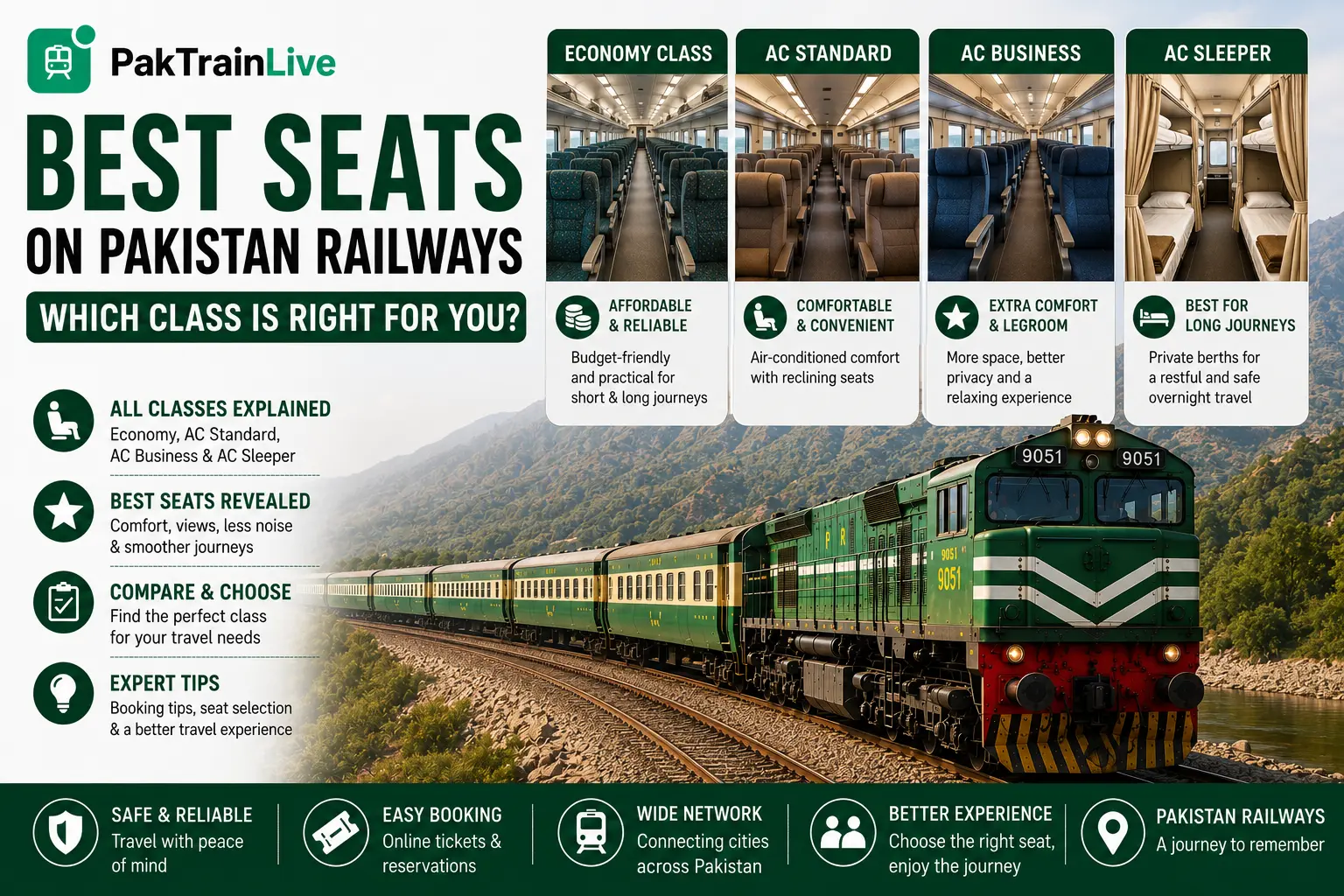
Seat choice on Pakistan Railways is often treated as a budget question when it should really be treated as a trip-design question. The right class or berth depends on what kind of journey you are taking, how long it is, and what state you need to be in when you arrive.
Many passengers regret bookings not because the train was fundamentally bad, but because the seat decision ignored the actual demands of the trip. A small fare saving can become a large comfort loss on a long corridor, while an expensive upgrade can be wasted on a short daytime ride.
This guide helps you choose more rationally by linking class choice to travel purpose instead of generic status assumptions.
Start With Trip Length, Not With Price
A short intercity ride and a full overnight trunk-line journey do not deserve the same decision framework. On shorter routes, price sensitivity can dominate. On longer routes, fatigue and posture become much more important.
The longer the trip, the more the seat becomes part of the product rather than a minor detail. This is especially true when arrival matters for work, weddings, exams, or caring for family.
Ask a simple question first: how much of this trip will I still be feeling tomorrow?
When Economy Class Makes Sense
Economy class works well for short intercity routes where you will be awake most or all of the trip. The fare difference can be meaningful, and comfort matters less when the journey is only a few hours. Business and leisure travelers on standard urban-to-urban routes often find economy sufficient if they accept sitting upright for the duration.
The mistake is treating economy as universally cheap rather than situationally cheap. On a 4-hour daytime route, it is genuinely reasonable. On a 12-hour overnight trip, false economy creates real regret the next day.
- You are traveling on a shorter daytime route
- Budget is the clear top priority
- You already know the route and handle basic discomfort well
- Arrival freshness matters less than cost savings
- You have packed light and are not managing a complex family trip
Understanding Pakistan Railways Class Types
Pakistan Railways typically offers multiple class options, each with different seat configurations, legroom, amenities, and price points. Understanding what each class actually provides beyond the name is critical for making a good choice.
Economy and Ordinary classes are budget-focused with basic seating and standing-room potential on crowded services. First Class and Higher classes offer reserved seating with better spacing and often additional amenities. Sleeper classes on overnight services provide berths for horizontal rest.
The key is matching the class to the trip reality. A First Class seat on a 6-hour daytime route may feel unnecessary. The same class on a 14-hour overnight journey can feel like a reasonable investment that determines whether you arrive rested or exhausted.
When a Better Seat Is Worth Paying For
Upgrading is usually worth it when the trip is long, the weather is harsh, or the consequence of arriving exhausted is high. Better seating can reduce stress enough to improve the whole trip experience and reshape how you remember the journey.
Business travel, elder travel, overnight movement, and long trunk routes are all strong candidates for paying more because the seat directly affects your ability to function after arrival.
The mistake many passengers make is comparing fares in isolation instead of comparing the total cost of discomfort versus the value of arriving in better condition.
How Different Travelers Should Decide
Your traveler type shapes what good seat choice actually means. A solo traveler on a familiar route can prioritize budget and accept basic discomfort. A family with young children should prioritize space, light supervision options, and manageable boarding.
Older travelers should choose the class that requires the least physical effort and strain. That might mean paying more for sleeper comfort on overnight routes even if they could technically endure economy. Business travelers should think about whether the trip requires arriving in meeting-ready condition or not—sometimes a better seat justifies its cost by improving arrival quality.
Rail enthusiasts may choose differently based on route scenery or the character of the service, but even they should not ignore fatigue as a real constraint on trip enjoyment.
- Solo budget traveler: optimize for acceptable discomfort rather than prestige
- Family with children: prioritize reduced chaos and better space management
- Older traveler: choose the option that minimizes physical strain
- Business traveler: pay for arrival usefulness, not for branding
- Rail enthusiast: decide whether scenery, sleep, or route identity matters most
Common Booking Mistakes
- Buying the cheapest option for a route that is too long to treat casually
- Paying for an upgrade on a trip too short to benefit from it
- Ignoring weather when choosing AC versus non-AC classes
- Forgetting that pickup and next-day obligations affect the value of comfort
- Not checking live train performance and route expectations before locking the decision
A Better Decision Framework
- Classify the trip as short, medium, long, or overnight.
- Decide what matters most: budget, rest, arrival readiness, or family ease.
- Compare fare difference against the cost of fatigue.
- Check fare information and your train on PakTrainLive.
- Book the class that fits the purpose of this trip, not your abstract self-image as a traveler.
Why Seat Choice Is Really Time Choice
At a deeper level, a seat purchase is often a time purchase. Better rest means less recovery time, less wasted evening after arrival, and fewer knock-on problems the next day.
That is why the right class is not always the cheapest class, and the best-value class is not always the most expensive one either.
Serious travelers make the decision in terms of outcomes, not branding.
The Decision Behind the Decision
Guides like this are useful because rail passengers often think they are making one simple purchase when they are actually making a chain of connected choices. A ticket, class, or booking action changes sleep quality, stress levels, family coordination, and even how much recovery time is needed after arrival. Once you see those connections, better travel decisions become much easier.
This is also why seemingly small details deserve serious attention. The best travel advice is rarely glamorous. It is usually a disciplined approach to preparation: knowing the route, choosing the right class, confirming the documents, and using live information instead of assumptions. Those habits create more value than chasing prestige or false economy.
For Pakistan Railways in particular, practical literacy matters because the network rewards passengers who engage with it intelligently. The more you understand how to match a trip to the right booking and the right expectations, the more consistently rail becomes a useful, repeatable part of your travel life rather than a gamble.
How PakTrainLive Fits In
PakTrainLive helps because it gives you route and train context before you book. Knowing how a train behaves, what its delay history looks like, and how long the route actually feels makes seat choice more rational and more connected to real journey outcomes rather than abstract assumptions.
The best seat on Pakistan Railways is the one that fits the actual job of the trip. Once you accept that principle—that comfort is not luxury but strategy—booking becomes much easier. Choose with purpose, and the journey becomes something you can control rather than something that merely happens to you.