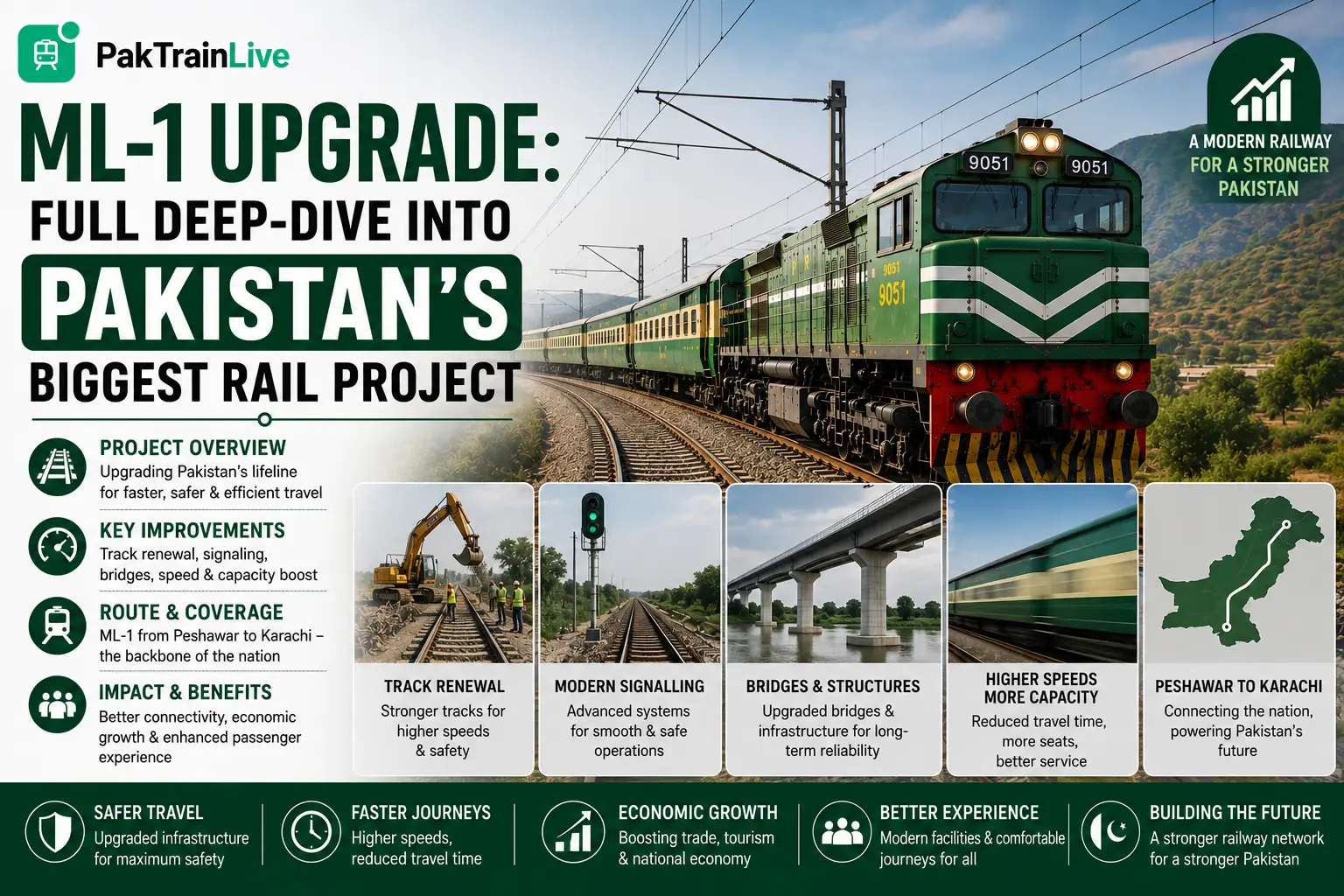
ML-1 is not just another railway project. It is the backbone question for the future of passenger and freight movement in Pakistan because it addresses the main north-south corridor on which so much of the system depends.
When people talk about faster trains, better punctuality, safer operations, or rail becoming more competitive with road and air, they are usually talking about outcomes that in some way trace back to ML-1.
This deep-dive explains the project in practical terms: what the corridor is, why the upgrade matters, where the gains could come from, and what travelers should realistically expect rather than simply hope for.
What ML-1 Actually Is
Main Line 1 is the strategic trunk route connecting Karachi in the south to Peshawar in the north through the densest and most economically significant population belt in the country.
Because it carries a large share of the railway’s most important movement, weaknesses on ML-1 propagate through the rest of the system. A corridor this central affects not only the trains running directly on it but also the credibility of rail as a national transport mode.
That is why upgrading ML-1 is better understood as systemic repair and modernization, not merely localized infrastructure work. The route encompasses everything from track geometry and signaling to station facilities and operational procedures.
The Phasing and Timeline Question
ML-1 is not expected to happen all at once. Practical infrastructure usually unfolds in phases: early sections, priority corridors, and later expansion. Understanding the phasing is important because it helps manage expectations about when passengers will actually see improvements.
Early phases typically target the highest-traffic segments or the highest-risk sections where accident rate or congestion is worst. This means passengers on some portions might see improvement years before other stretches are upgraded.
This uneven rollout is normal but can feel frustrating. A corridor where half the route is modernized but half is still operating under old constraints can create a strange passenger experience where improvements feel incomplete.
Why the Existing Corridor Faces Constraints
Legacy track condition, signaling limitations, speed restrictions, and the operational burden of heavy corridor demand all combine to limit what the line can currently deliver.
Passengers experience those constraints as longer travel times, uncertain punctuality, and a ceiling on how modern the passenger offer can feel even when trains themselves improve.
In infrastructure terms, the problem is not that one train is slow. The problem is that the core corridor imposes structural limits on the whole system’s ambition.
What the Upgrade Is Trying to Change
The upgrade conversation usually centers on higher line speeds, better signaling, improved safety, stronger track geometry, and a corridor that can handle traffic more efficiently.
Those changes matter because they stack. Faster permitted speeds alone do not transform rail unless the wider operating environment also becomes more dependable and capacity-aware.
In other words, modernization only matters if it reduces the friction that currently eats away at the timetable in daily operations.
- Higher operating speeds on upgraded sections
- Better signaling and control logic
- Reduced safety risk at key infrastructure points
- More dependable long-distance timing
- Greater strategic credibility for intercity passenger rail
What It Could Mean for Passengers
The clearest passenger benefit would be a shorter and more believable timetable on major city pairs. Reduced journey time matters, but so does the expectation that the schedule can actually be trusted.
A corridor with stronger infrastructure also opens the door to more ambitious product design. Faster trains, improved onboard planning, better rolling stock utilization, and more coherent intercity schedules become easier when the line beneath them is less fragile.
This could change how passengers evaluate rail versus flights or road coaches, especially on corridors where airport overhead or highway fatigue already create friction.
Why Travel Time Is Not the Only Metric
Public discussions often fixate on the most dramatic speed headline, but corridor modernization should also be judged by punctuality, resilience, maintenance logic, and overall service confidence.
A train that is somewhat faster but still operationally erratic does not transform travel behavior. A train that is meaningfully faster and more dependable can, because travelers make modal choices based on overall reliability more than they make them based on speed alone.
That distinction matters because transport choices are often driven by trust rather than theory. A corridor with a reputation for consistent performance attracts more users, even if not every trip is slightly faster than before.
Economic and Network Effects
An upgraded main line strengthens more than passenger comfort. It changes freight reliability, corridor throughput, and the broader policy conversation around whether rail can carry a larger national role in both passenger and goods movement.
For cities, stations, and secondary routes connected into the trunk, improvements on ML-1 can produce indirect benefits even where no passenger sees a dramatic new train overnight. Better main-line performance means more dependable connections, more efficient rolling stock utilization, and a corridor strong enough to support network growth.
From a financial perspective, an upgraded corridor also becomes more attractive to private operators and international funding, which in turn unlocks investment for systems that previously seemed too risky or too marginal.
This is how serious infrastructure works: not only through visible speed, but through quieter improvements in network confidence, financial viability, and the ability to attract resources that were previously unavailable.
What Travelers Should Expect in the Near Term
Passengers should resist the temptation to treat ML-1 as a switch that turns the system into a different railway overnight. Large infrastructure projects unfold in stages, and real passenger benefits often appear unevenly before they feel system-wide.
The mature expectation is incremental improvement with major long-term potential. That is less exciting than hype, but far more useful for planning around the real future of rail travel in Pakistan.
In the meantime, current journey planning still depends on live status and route awareness rather than distant promises.
What Readers Should Watch Going Forward
Analytical topics like this matter most when they improve how readers interpret future events. The point is not only to understand the current state of the railway, but also to recognize which signals indicate real improvement and which ones are mostly rhetorical. Better passenger information, more believable timetables, stronger corridor reliability, and clearer service identity usually matter more than isolated announcements.
That is why informed readers should track outcomes rather than slogans. When infrastructure, technology, or operating practice improves, those improvements should eventually show up in the lived experience of passengers. If they do not, the story is incomplete. Serious railway analysis always returns to that test: what changed for real people on real journeys?
Using PakTrainLive alongside broader reporting helps create that grounded view. News and policy language explain ambition, while live route behavior shows the system as it actually performs. The combination is far more informative than either source alone.
What It Means for Travelers
ML-1 matters because it is the corridor on which much of Pakistan Railways’ future seriousness depends. If it improves materially, passengers will eventually feel the difference not only in speed but in trust.
Until then, tools like PakTrainLive, the live schedule search, and route pages remain the best way to navigate the railway as it exists today rather than as policy language imagines it tomorrow.