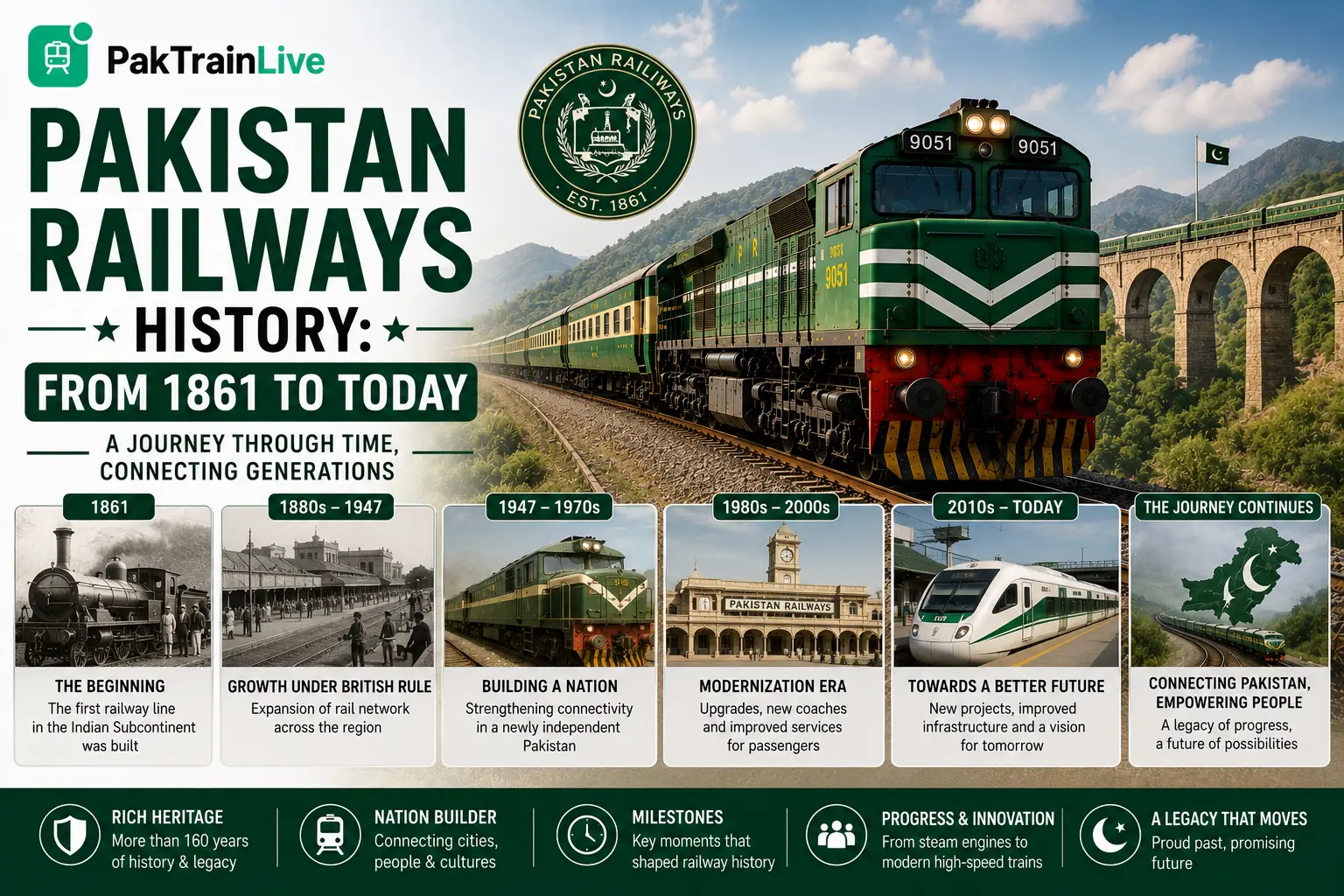
Pakistan Railways cannot be understood only as a transport operator. It is also a historical system shaped by colonial infrastructure logic, post-independence state-building, regional geography, changing economic priorities, and the persistent question of how rail fits into national development. The system carries layers of political decisions, technological choices, and social memory that are embedded in every route.
That long history matters because today’s passenger experience did not appear from nowhere. Station architecture, corridor hierarchy, route identities, and even common frustrations often have deep roots in decisions made decades earlier. Understanding that history makes the railway less mysterious and more legible as a system.
This overview does not try to be a full academic history. Instead, it traces the major phases that explain how the railway became what it is, why it still commands cultural and practical importance, and why modernization conversations usually invoke historical context even when talking about futures.
Colonial Origins
Rail infrastructure on the territory that is now Pakistan developed in the nineteenth century within the priorities of empire: military mobility, administrative control, and the movement of goods across strategically important corridors.
Lines were not laid primarily to create a democratic passenger network in the modern sense. They were built to serve broader political and economic objectives, though passengers naturally became part of the system’s social life over time.
This origin helps explain why some corridors are so deeply entrenched and why the network’s geography still reflects historical power patterns.
Partition and Reorganization
Partition imposed a profound institutional and operational rupture. Railways were not just inherited infrastructure; they were suddenly part of a new national state dealing with urgent movement, administration, and identity formation.
The system that became Pakistan Railways had to operate under new political conditions while still relying on inherited assets, route logic, and corridor structures.
That period embedded the railway into national memory not just as transport but as witness to one of the most consequential population movements in South Asian history.
The Era of National Reach
For many decades rail represented one of the most visible ways of connecting distant regions. Major named trains became part of public culture, and stations acted as civic landmarks as much as boarding points.
In this era the railway’s importance lay not only in technical movement but in social cohesion. It gave people a shared map of the country through named services, recurring routes, and familiar station narratives.
That cultural role still lingers today, especially in how older generations talk about trains with a mix of practicality and memory.
Competition and Decline Pressures
As road transport expanded and policy attention shifted, rail faced growing competition. Parts of the network experienced underinvestment, slower modernization, and reduced confidence from users who increasingly treated buses or flights as more dependable alternatives for time-sensitive travel.
The result was not total collapse but a long period in which the railway’s symbolic importance often exceeded its operational confidence. Some routes became less frequent, maintenance suffered in places, and passenger perception shifted toward ‘rail as a legacy system’ rather than ‘rail as progress.’
This tension is essential to understanding present-day reform debates: the railway remains nationally important, but importance alone does not solve infrastructure constraints. Passengers want the railway to work better, but demand alone without capital investment cannot rebuild trust.
Structural Challenges and Reform Attempts
Through the 1990s and 2000s, Pakistan Railways struggled with aging rolling stock, deferred maintenance on track and signaling, and operational constraints that limited both speed and frequency on major routes. Modernization was discussed but funding remained inconsistent.
Various administration launched reform efforts and operational improvements, but the scale of the challenge meant that incremental changes could not fundamentally shift trajectory. The railway needed structural investment and policy backing, not just operational tinkering.
That backdrop explains why current initiatives around ML-1 and live tracking technologies feel like more serious attempts at modernization. They represent a recognition that the railway’s future depends on visible infrastructure change and restored passenger confidence, not merely on nostalgia.
Why the Railway Still Matters
Despite those pressures, Pakistan Railways continues to matter because it connects large populations, offers an alternative cost structure to road and air, and retains corridor relevance that no policy conversation can casually dismiss. For a developing country with limited infrastructure resources, a rail network that already exists has inherent value that cannot be easily replicated by building new roads.
For many passengers the railway remains a practical necessity—it is often the only affordable way to connect between distant cities. For others it is a preferred mode when reliability, visibility, and comfort are strong enough to justify choosing it over road buses or air travel.
And for the state, rail still carries strategic significance in a way that goes beyond nostalgia. It affects freight movement, urban planning around stations, regional connectivity, and the perceived modernity of the transport sector as a whole.
- National corridor connectivity linking all major cities
- Potential for large-scale passenger movement at scale that road alone cannot replicate
- Strong symbolic and civic presence in station architecture and public memory
- Relevance to freight, container, and infrastructure policy
- A continuing role in debates about sustainable transport and urbanization
Modernization and the Present Moment
Today the conversation around Pakistan Railways often centers on whether infrastructure upgrades, better tracking, improved rolling stock, and more coherent operations can rebuild trust.
This is where history becomes practical. A railway with such deep roots carries both burden and advantage: burden because legacy problems are real, advantage because the corridor logic and public familiarity already exist.
In effect, the question is not whether rail belongs in Pakistan’s future. The question is how seriously the system will be upgraded to match that future.
What Readers Should Watch Going Forward
Analytical topics like this matter most when they improve how readers interpret future events. The point is not only to understand the current state of the railway, but also to recognize which signals indicate real improvement and which ones are mostly rhetorical. Better passenger information, more believable timetables, stronger corridor reliability, and clearer service identity usually matter more than isolated announcements.
That is why informed readers should track outcomes rather than slogans. When infrastructure, technology, or operating practice improves, those improvements should eventually show up in the lived experience of passengers. If they do not, the story is incomplete. Serious railway analysis always returns to that test: what changed for real people on real journeys?
Using PakTrainLive alongside broader reporting helps create that grounded view. News and policy language explain ambition, while live route behavior shows the system as it actually performs. The combination is far more informative than either source alone.
What It Means for Travelers
For travelers using the network now, history is not just background reading. It explains why some routes feel grand, why certain stations carry unusual importance, and why modernization tools like live train tracking matter so much. The railway is not just infrastructure; it is part of the country's story.
PakTrainLive sits within that longer story by giving passengers a clearer view of the railway as it operates today while the larger infrastructure story continues to unfold. Technology alone cannot fix historical underinvestment, but better information can help passengers navigate the railway more confidently until systemic modernization takes root.