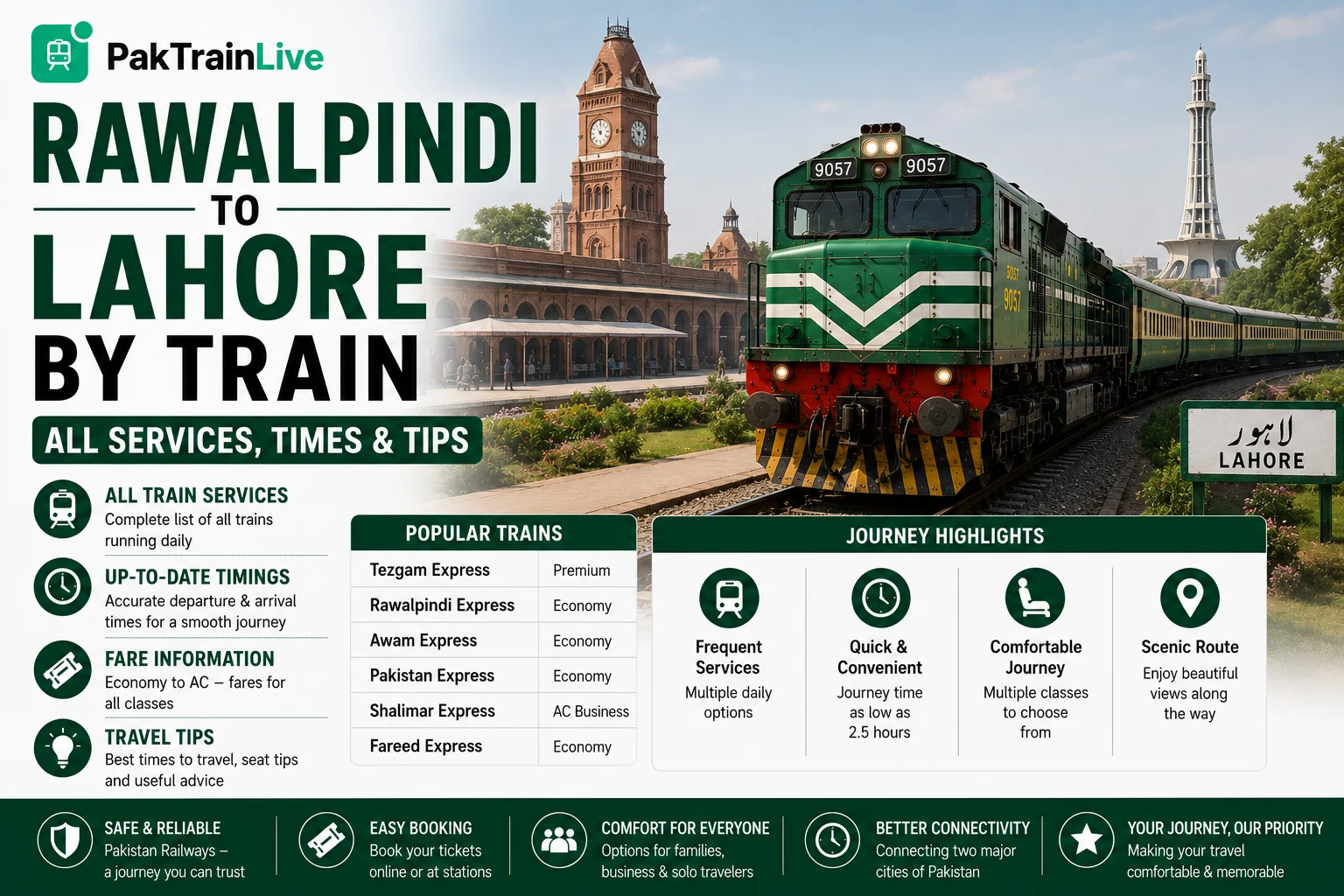
Rawalpindi to Lahore is one of the most practical intercity rail journeys in Pakistan because it connects two dense urban centers without the overhead of airport travel. For many passengers it is not a romantic long-distance trip but a repeatable working route used for business, family visits, exams, and medical appointments.
That repeatable nature is exactly why good planning matters. When a route becomes familiar, travelers start making assumptions about timing and station routines. Those assumptions are often what cause missed departures, unnecessary stress, or poor class choices on days when the route is busier than usual.
This guide is designed for real use. It is less about rail nostalgia and more about getting from Rawalpindi to Lahore with fewer surprises, better expectations, and a stronger understanding of how to use live information instead of static schedules.
Journey Time and Rhythm
Depending on the train and stop pattern, passengers should generally think in terms of four to six hours. Faster services reduce intermediate halts, while slower trains may trade speed for broader regional coverage.
This makes the route attractive for same-day travel. Many passengers can leave in the morning, complete a meeting or family errand, and either stay overnight or return the next day without treating the trip as a major expedition.
The main timing risk is not usually the absolute length of the ride. It is the cumulative friction around departure time, station entry, boarding pressure, and arrival into a busy city. That is why a supposedly simple corridor still rewards preparation.
Best Trains for This Route
| Train | Typical role | Why passengers choose it |
|---|---|---|
| Subak Raftar | Business-oriented express | Often considered when travelers want a clearer intercity focus and shorter-feeling travel day |
| Tezgam / major expresses | Longer-distance trains on shared corridor | Useful when schedule alignment matters more than the train’s overall branding |
| Mail and mixed-stop services | Broader stop coverage | Suitable if your actual origin or destination sits between the headline cities |
For this route, departure time can matter more than train name. A well-timed service that matches your workday or family schedule will often be better than a more famous train that departs at an inconvenient hour.
Passengers meeting strict deadlines should prefer a service whose timetable gives them breathing room after arrival. Even modest delays matter more on a same-day business trip than they do on a leisurely family visit.
Major Stops and What They Mean
One reason the Rawalpindi to Lahore corridor remains useful is that it connects more than just the endpoints. The stop pattern influences boarding crowds, catering quality, and even punctuality, so travelers should read the route as a chain of regional markets rather than a single straight trip.
- Gujranwala often acts as a meaningful progress marker because it signals the route’s movement through one of Punjab’s busiest urban-industrial belts.
- Gujrat and Jhelum help explain why some trains feel slower than expected: stronger stop coverage adds utility for regional passengers but changes the pace for end-to-end travelers.
- Lala Musa and surrounding junction logic can influence operational rhythm, especially when network traffic is dense.
If your stop is a secondary station rather than the terminus, keep your phone charged and watch the live map before arrival. That matters more on long-distance services where station dwell times can be short and platform announcements may be difficult to hear.
Booking Strategy and Class Selection
Travelers who need to arrive mentally fresh for meetings should not treat class selection as an afterthought. A quieter coach and better seating can materially improve the usefulness of the day.
If you are traveling with older family members, arrival ease matters just as much as onboard comfort. Choose a service and class that reduce boarding friction rather than optimizing only for price.
Window preferences, group seating, and near-door convenience all matter more on this route because boarding and disembarking happen relatively quickly.
PakTrainLive does not sell tickets, but it helps you compare trains before you commit. Use the live train directory, check the latest fare guide, and then book the service that best matches your schedule rather than automatically choosing the first option you find.
What to Expect On Board
This is short enough that you do not need overnight-style packing, but long enough that a charged phone, water bottle, and clear ticket access still matter.
Passengers often underestimate how tiring station-side waiting can be, especially in warmer months. A compact, efficient packing approach is better than carrying bulky luggage for a day trip.
If you expect to work during the ride, prepare for intermittent noise and variable comfort rather than assuming a quiet office-like environment.
Most long journeys become easier when you pack for infrastructure realities rather than the ideal brochure version of the trip. A water bottle, power bank, tissues, and a light layer solve most comfort issues better than overpacking luggage.
Weather and Seasonal Planning
Fog in winter can affect schedules across Punjab, and morning departures are particularly vulnerable to small but meaningful slippage.
Summer travel is more forgiving in trip length but less forgiving in station comfort, especially if you arrive too early and wait on crowded platforms.
Holiday periods change the passenger mix. Coaches may feel more family-heavy and station movement slower, so travel with a little more patience built in.
This is also why flexible expectations matter. A route that feels simple in mild weather can become tiring when heat, fog, or holiday demand compresses station operations. Build margin into your itinerary if a meeting, wedding, or onward bus connection matters.
Arrival, Transfers, and Last-Mile Planning
Lahore arrival is usually straightforward if you have already decided how you are leaving the station. The confusion starts when passengers step out without a pickup plan, address confirmation, or realistic understanding of city traffic.
If you are connecting onward to another part of Lahore, give yourself transfer margin. A train arriving near its expected time can still be followed by a slow city transfer depending on the hour.
Those heading onward to academic, government, or medical appointments should avoid over-scheduling the first hour after arrival.
For first-time travelers, the station exit often creates more stress than the train ride itself. Decide in advance how you will leave the station, how much luggage you can comfortably move alone, and whether your arrival time makes local transport easy or inconvenient.
Mistakes First-Time Travelers Make
- Treating the route like a casual commute and arriving at the station too late
- Booking purely on price for a day where you need to work immediately after arrival
- Ignoring winter fog risk on early departures
- Failing to compare more than one train before committing
- Not checking live updates before leaving home or office
None of these mistakes are catastrophic, but together they create the impression that rail travel is harder than it really is. The reality is that most journeys go smoothly when passengers plan around timing, class, and station logistics instead of treating the trip like a last-minute bus ride.
Who Should Take This Journey by Rail
Rail is strongest on routes like the Rawalpindi to Lahore corridor when the traveler values predictable luggage handling, city-center to city-center movement, and the ability to stay connected to the actual progress of the trip. That makes it especially useful for families, students, budget-conscious professionals, and people who simply prefer a slower but more legible form of long-distance travel.
It is less ideal for passengers whose plans collapse if even a moderate delay appears. In those cases, the right choice may still be rail, but only if the traveler gives themselves enough margin to absorb real operating conditions. Matching the mode to the consequences of arrival is one of the most mature travel decisions a passenger can make.
That perspective also explains why route guides matter. A train journey is not just a timetable and a seat number. It is a moving chain of decisions about comfort, timing, station behavior, and onward transport. Passengers who understand that tend to find rail more useful and more enjoyable than those who expect it to behave like a completely frictionless airline substitute.
How PakTrainLive Helps on Travel Day
On short and medium intercity routes, live tracking is less about dramatic long-distance monitoring and more about making departure and pickup decisions at the correct time.
PakTrainLive helps you avoid wasted station waits by showing whether the train is moving as expected. That matters for both the departing traveler and anyone receiving them in Lahore.
Before leaving home, check the schedule search and your chosen service on PakTrainLive. On the platform, refresh once more. That simple habit reduces missed departures, unnecessary waiting, and confusion about whether a train is actually on time.