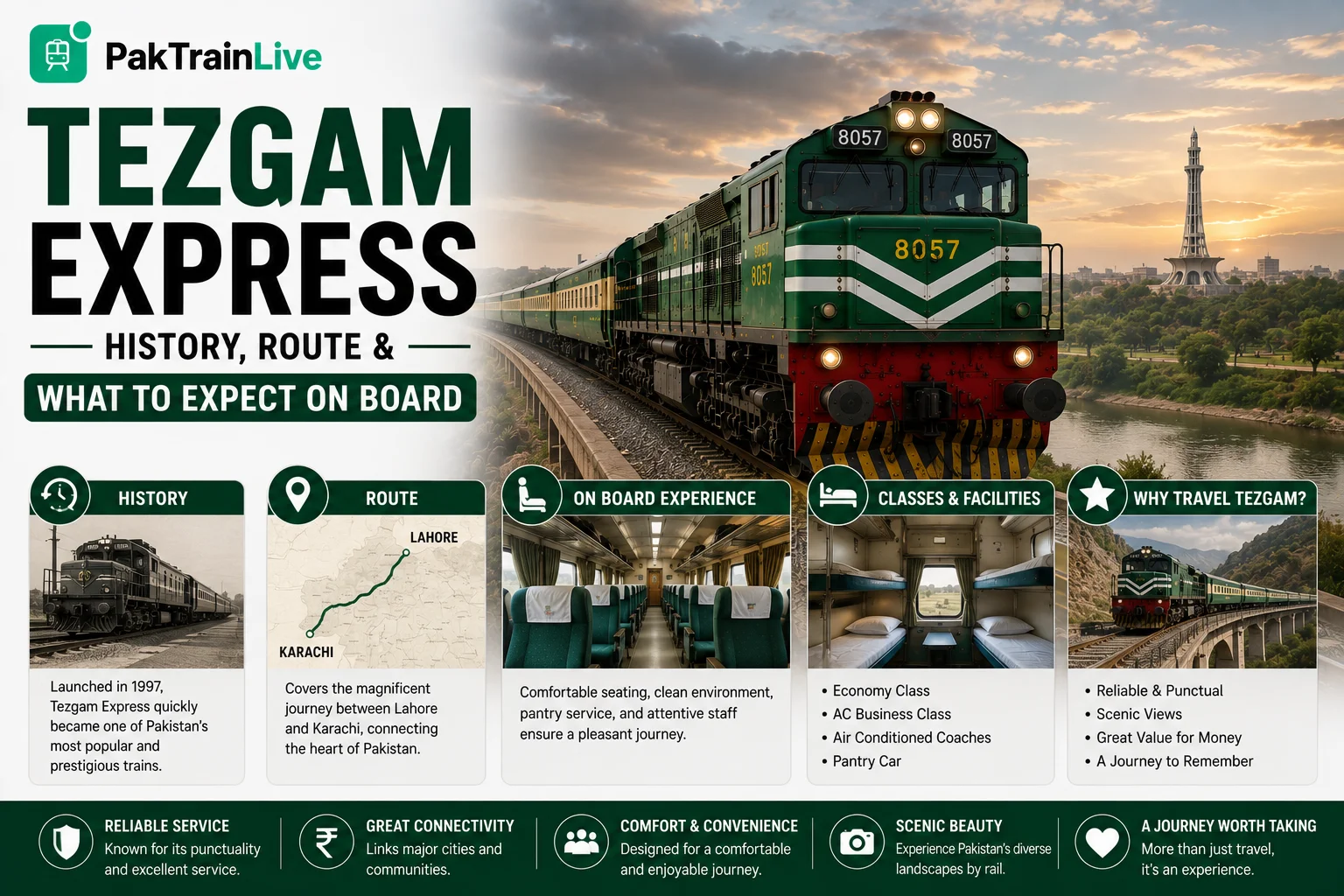
Tezgam Express is one of the best-known names in Pakistan Railways. Even people who do not follow trains closely often recognize it, which says something about its longevity and the way it has embedded itself in travel culture across generations.
That familiarity can be misleading. A famous train is not automatically understood. Passengers booking Tezgam for the first time still need to know what sort of service it actually is, what kind of ride it offers today, and when it is the right choice compared with other north-south expresses.
This article treats Tezgam as both a historical institution and a working piece of transport infrastructure. That combination is the only sensible way to evaluate a train that carries so much name recognition.
History and Reputation
Tezgam’s brand strength comes from persistence. Over decades, it has represented the idea of the classic intercity express: named, recognized, and associated with major urban links rather than obscure branch-line utility.
That history gives the train cultural capital. Families mention it in travel planning because parents and grandparents already know the name, and that inherited trust still influences booking behavior today.
But inherited trust should be paired with current information. Operational reality evolves, and passengers should combine historical reputation with live data and current timetable awareness.
Route, Purpose, and Identity
Tezgam’s route logic makes it central to national intercity movement. It sits on the main trunk dynamics that define how passengers understand long-distance rail between major population centers.
This matters because the train is often chosen not just for end-to-end travel but for strong city pairs along the way. It performs more than one role simultaneously: prestige service, recognisable option, and practical corridor connector.
That layered function is part of why it remains relevant even as newer or differently branded services compete for attention.
Coaches, Classes, and Rolling Stock
Passengers should think of Tezgam as a service where coach choice can shape the whole memory of the trip. On a train with a legacy brand, expectations are often higher, so mismatching your comfort needs with the chosen class can lead to disappointment.
Travelers prioritizing rest, lower noise, or a stronger chance of arriving usable for work should consider classes that reduce fatigue rather than chasing only the lowest fare.
At the same time, budget travelers may still find the train entirely workable if they plan realistically and do not assume the brand name means premium conditions in every coach.
When travelers compare services only on headline travel time, they often miss the operational personality of a train. A train with slightly longer running time can still be the smarter option if its stop pattern, boarding station, or coach mix better matches your actual needs.
What the Ride Feels Like
Tezgam tends to feel like a serious intercity service rather than a novelty ride. That means the experience is defined by boarding flow, passengers in transit for multiple reasons, and a rhythm that reflects the main line’s importance.
Because it is so well known, expectations can vary widely inside the same coach. Some riders are nostalgic, some are experienced commuters, and some are first-timers trying to decide whether rail was the right choice.
The best mindset is to approach the train as a reliable named service that still benefits from ordinary travel discipline: pack efficiently, check status before departure, and do not outsource your comfort entirely to branding.
Rail fans notice these details instinctively, but ordinary passengers benefit from them too. A good train is not just the one that moves fast; it is the one whose boarding, seat comfort, overnight rhythm, and arrival timing line up with the purpose of the trip.
Scenery and Route Character
Tezgam is not marketed primarily as a scenic train, but its route still offers a strong sense of Pakistan’s intercity geography. The changing station cadence and corridor scale give it more texture than a purely functional transport option.
For travelers who enjoy watching how major cities connect through the rail spine, the train offers a clear view of the network’s social and economic importance.
That subtle scenic quality is different from mountain drama, but it remains valuable for passengers who appreciate the lived geography of a country rather than only postcard landscapes.
Who This Train Is Best For
Tezgam suits passengers who want a service with national recognition and a long-established place in the system. It also works well for travelers who prefer the confidence of a known named train over a less familiar alternative.
It is especially appropriate for passengers making classic trunk-line journeys where both endpoints and intermediate logistics align well with the train’s operating role.
If your main priority is purely premium feel, compare current alternatives. If your priority is a strong intercity rail identity backed by live status tools, Tezgam remains compelling.
That is why spotlighting individual trains matters. Two services may connect similar cities, but the passenger experience can differ dramatically depending on departure hour, coach condition, stop density, and the type of traveler using the train.
Booking and Boarding Tips
Do not let the train’s brand familiarity tempt you into lazy planning. Check your coach, departure hour, station entry time, and transfer needs with the same care you would give any other long-distance journey.
If you are sending a family member alone, share the live tracking page in advance. That one step reduces a lot of uncertainty once the train is underway.
When comparing trains, ask the practical question first: which option fits my actual day? The most iconic train is not always the best fit for a specific appointment or connection.
Use the live train pages and route search tools before booking. If your plan is flexible, compare alternatives instead of assuming the most famous service is automatically the best choice every single day.
How This Train Compares With Similar Services
The easiest mistake passengers make is to compare trains only by headline fame or approximate running time. In practice, trains compete through a wider bundle of qualities: departure hour, coach condition, passenger mix, stop pattern, and how believable the arrival timing feels once the route is underway. A train with a legendary name may still be the wrong choice for a specific day if another service fits the trip more cleanly.
That does not reduce the value of Tezgam Express. It clarifies it. A train becomes more impressive when you understand exactly where it wins and where it should be judged more cautiously. Travelers who compare services this way usually end up happier with their booking because they are choosing for fit rather than myth.
For readers using PakTrainLive, this is where live context matters. Looking at the service in isolation tells only part of the story. Comparing it against other active trains on the corridor gives a better sense of whether you are choosing heritage, convenience, speed, comfort, or route identity as the dominant priority.
How to Track It Live
Tezgam is exactly the kind of service where live tracking adds value because so many people are coordinating around it. Students, business travelers, relatives, and station pickups all benefit from knowing whether the train is moving as expected.
PakTrainLive makes that easier by showing current position and route progress instead of forcing passengers to rely on guesswork or outdated assumptions.
On PakTrainLive you can open the service, check progress station by station, and compare the live position with the public timetable. That is especially useful when someone is collecting you from the station or when you need to estimate whether the train will arrive close to its advertised time.