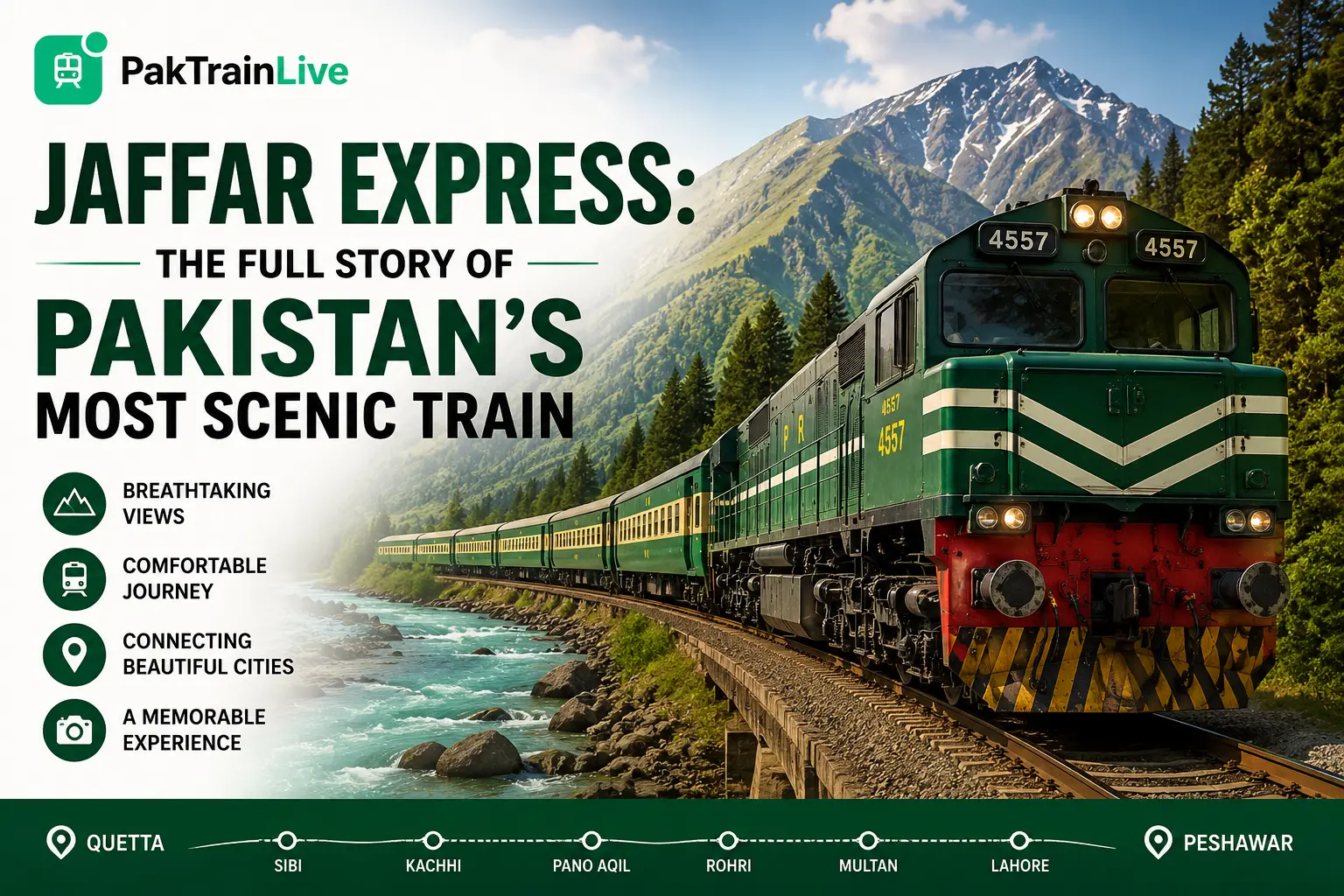
Jaffar Express occupies a special place in Pakistan Railways because it is both functional and mythic. For ordinary passengers it is a crucial long-distance service linking major regions; for rail enthusiasts it is one of the most scenic and characterful trains in the system.
That dual identity matters. Some trains are famous because they are fast, others because they are premium, and others because they sit at the center of national memory. Jaffar Express stands out because it represents terrain, distance, and endurance in a way few other services do.
If you are considering the train, you need more than a timetable. You need to understand what kind of ride it is, what kind of traveler benefits most from it, and how route realities shape the onboard experience.
History and Reputation
Named within a broader tradition of giving prestige identities to major services, Jaffar Express became known as a train that connected places many Pakistanis think of as geographically distant in both culture and terrain.
Its reputation is strengthened by the environments it crosses. When a service repeatedly appears in travel conversations, news cycles, family migration stories, and railfan photography, it grows beyond simple transport and becomes part of the national railway imagination.
That is why the train continues to attract interest even from travelers who have multiple alternatives for parts of the same journey.
Route, Purpose, and Identity
The route’s defining quality is contrast. It links plains, junction cities, and mountain approaches rather than staying inside one easy travel zone. That makes the train feel like a moving cross-section of Pakistan rather than a single-purpose shuttle.
Operationally, the service performs a difficult job. It must remain relevant to end-to-end travelers while also serving passengers whose journeys begin or end at intermediate stops across a long alignment.
This broad role is one reason the train cannot be evaluated only on speed. Its significance lies in coverage, continuity, and access to landscapes that few other regular services deliver in the same way.
Coaches, Classes, and Rolling Stock
Passengers should check the available classes at booking time, because the real value of the trip changes depending on whether you are seated for sightseeing, resting overnight, or making a budget decision under time pressure.
On a route associated with dramatic terrain and long travel hours, class is not just a comfort upgrade. It changes how much energy you still have when the scenery becomes interesting or when the journey enters its more demanding late stages.
Families and first-time riders tend to benefit from prioritizing comfort over minimal savings, especially when the trip is also a memorable occasion rather than routine transport.
When travelers compare services only on headline travel time, they often miss the operational personality of a train. A train with slightly longer running time can still be the smarter option if its stop pattern, boarding station, or coach mix better matches your actual needs.
What the Ride Feels Like
The ride has a slower, more narrative quality than some trunk-line expresses. You feel the geography changing around you, and that creates a very different psychological experience from a flatter, more repetitive main-line corridor.
Passengers who enjoy rail travel as observation often find the trip deeply rewarding. Those expecting the cleanliness, predictability, or compressed timing of a premium short-hop service need to reset expectations before boarding.
Food, rest, and basic organization matter more here because the route invites you to stay mentally engaged for long stretches rather than simply sleeping through most of it.
Rail fans notice these details instinctively, but ordinary passengers benefit from them too. A good train is not just the one that moves fast; it is the one whose boarding, seat comfort, overnight rhythm, and arrival timing line up with the purpose of the trip.
Scenery and Route Character
The association with the Bolan region is central to the train’s appeal. The line’s relationship to cuttings, valleys, and rugged topography gives the train a visual identity that is difficult to replicate elsewhere in the network.
Scenery on this kind of train works best when you are prepared for it. A good seat choice, daylight timing on key sections, and simple readiness to put the phone down for a while can turn the trip from ordinary transport into one of the strongest rail experiences in the country.
This is one reason the train keeps appearing in recommendations for travelers who want more than mere utility.
Who This Train Is Best For
Jaffar Express is ideal for travelers who value route character, long-distance railway atmosphere, and the sense of seeing Pakistan through connected landscapes rather than isolated city terminals.
It is also useful for passengers whose origin-destination pair aligns naturally with the service. In those cases, the train is not just scenic but genuinely practical.
If your only objective is the absolute quickest point-to-point journey, another option may fit better. But if you want significance, landscape, and a memorable route identity, Jaffar Express is hard to ignore.
That is why spotlighting individual trains matters. Two services may connect similar cities, but the passenger experience can differ dramatically depending on departure hour, coach condition, stop density, and the type of traveler using the train.
Booking and Boarding Tips
Check the daylight portion of your expected trip and think about what part of the route you most want to experience awake. That simple planning step can meaningfully change how satisfying the journey feels.
Bring more patience than you would on a short intercity run. Scenic long-distance services are at their best when passengers accept that operational variability is part of the experience rather than a personal insult.
If you are traveling with family, explain the trip honestly beforehand. That creates better expectations around time, comfort, and the overall rhythm of the route.
Use the live train pages and route search tools before booking. If your plan is flexible, compare alternatives instead of assuming the most famous service is automatically the best choice every single day.
How This Train Compares With Similar Services
The easiest mistake passengers make is to compare trains only by headline fame or approximate running time. In practice, trains compete through a wider bundle of qualities: departure hour, coach condition, passenger mix, stop pattern, and how believable the arrival timing feels once the route is underway. A train with a legendary name may still be the wrong choice for a specific day if another service fits the trip more cleanly.
That does not reduce the value of Jaffar Express. It clarifies it. A train becomes more impressive when you understand exactly where it wins and where it should be judged more cautiously. Travelers who compare services this way usually end up happier with their booking because they are choosing for fit rather than myth.
For readers using PakTrainLive, this is where live context matters. Looking at the service in isolation tells only part of the story. Comparing it against other active trains on the corridor gives a better sense of whether you are choosing heritage, convenience, speed, comfort, or route identity as the dominant priority.
How to Track It Live
Live tracking is particularly helpful on a service like Jaffar Express because pickup coordination and arrival forecasting are otherwise difficult across such a long and variable route.
PakTrainLive helps passengers and families see where the train actually is, not where they hope it should be. For a service with this kind of symbolic and practical importance, that clarity has real value.
On PakTrainLive you can open the service, check progress station by station, and compare the live position with the public timetable. That is especially useful when someone is collecting you from the station or when you need to estimate whether the train will arrive close to its advertised time.